Our team works across ≈ 60 code repositories split between five organisations. At that size the hard question is no longer how to write the code but where things are, and what moved this week. Answering it used to mean opening a terminal and remembering names.
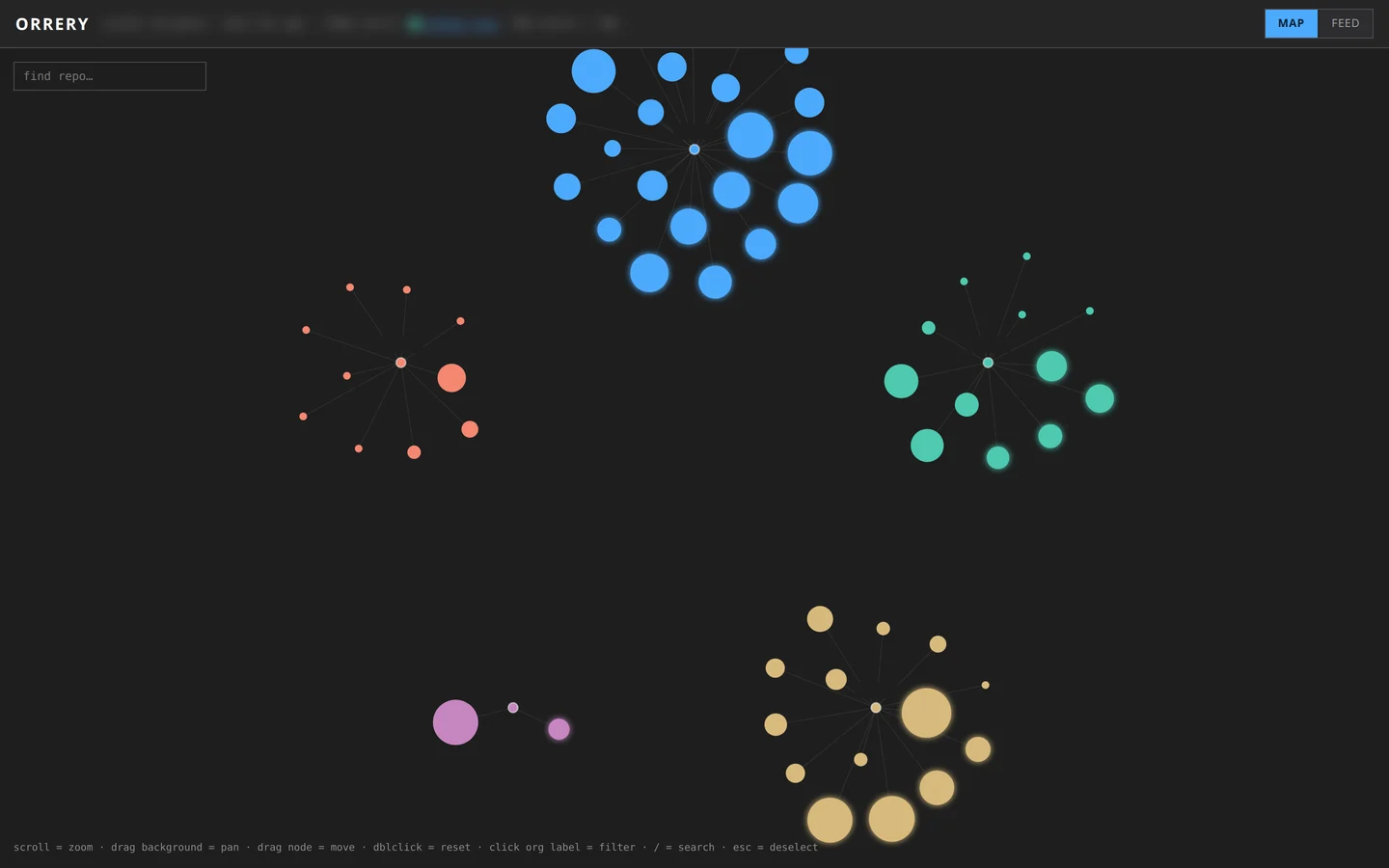
The navigator places every repository on one map, grouped by organisation and sized by recent activity, with a feed of commits and review verdicts beside it. It answers “where is this, and what moved this week” without opening a terminal.
A search box finds a repository by name, and clicking an organisation filters the map to it. The map is rebuilt from the repositories themselves each time it loads, so it cannot drift from what is actually there.
The software itself
Screens from the running tool. Authors, repository names and change descriptions are blurred on the timeline; on the map, organisation and repository names and the activity counters are hidden.

Why it holds
Nothing on the map is maintained by hand. A list of repositories typed into a page goes stale the week someone adds one; a map read from the source does not.
The navigator is plain Python and JavaScript, with no framework and no third-party package. The same approach carries over to a business: one map of your systems, read from the systems themselves.
SCOPE AND LIMITS
This is an internal tool, not a product. It is not sold, and it appears here for its interface rather than as a deliverable. It runs on the team’s own machine.