Toute petite entreprise assemble la même pile : identité, fichiers, clavardage, hébergement Git, un ERP, un coffre à mots de passe, de la surveillance. La voie habituelle est un abonnement mensuel pour chacun, ce qui va vite, et ce qui pose les dossiers de l'entreprise sur l'infrastructure d'un tiers, dans la juridiction d'un tiers. Au Québec, ce n'est pas une affaire de goût. La Loi 25 fait de la résidence des données une exigence légale.
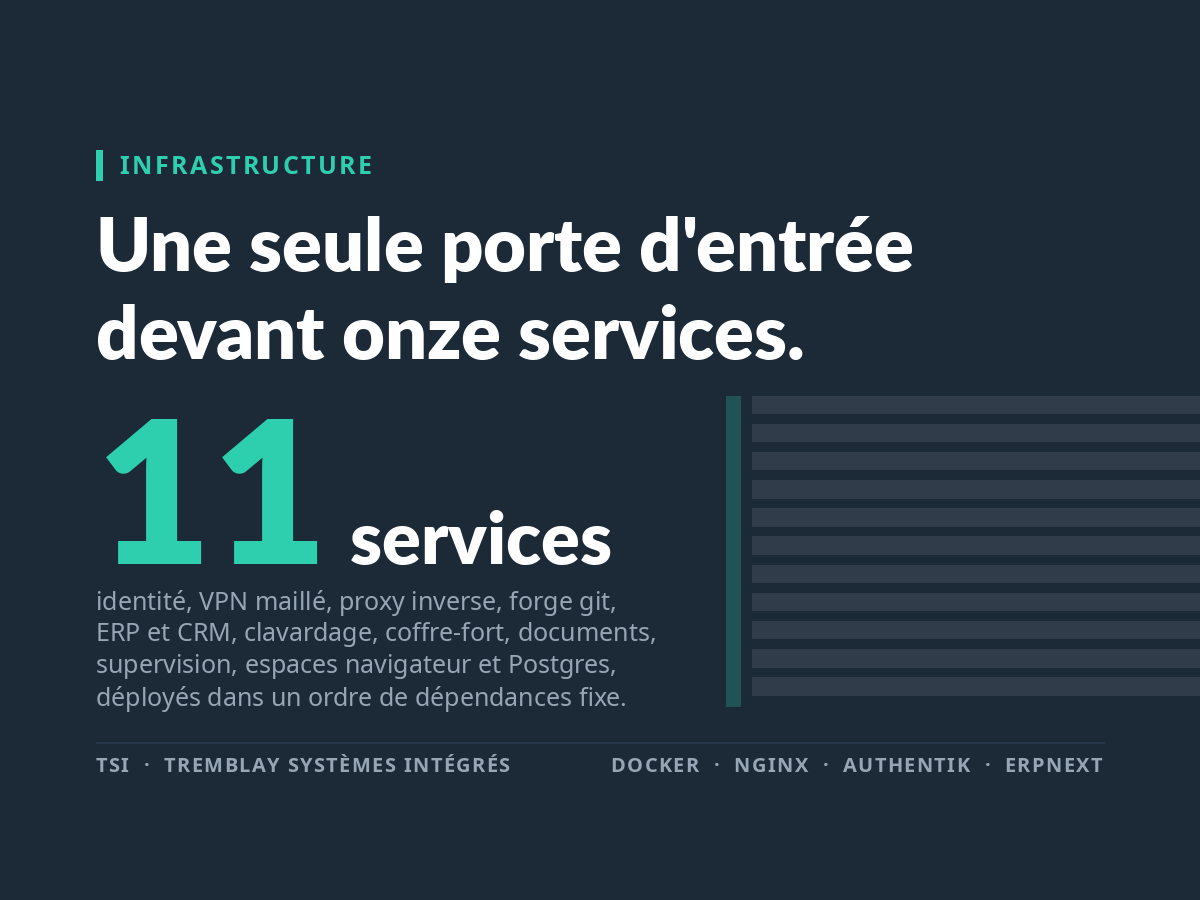
Voici donc cette pile, auto-hébergée, sur une infrastructure que nous contrôlons. Onze services derrière une seule authentification : identité et MFA devant tout le reste, un RPV maillé pour que rien d'autre que le proxy inverse ne soit exposé à Internet, un proxy inverse à TLS automatique, une forge Git avec tickets et recherche de code, ERP et CRM, clavardage d'équipe, coffre à mots de passe, gestion documentaire avec ROC, SIEM et surveillance des postes, espaces de navigation isolés, et un Postgres géré derrière les services qui en demandent un.
Ce que nous avons mesuré
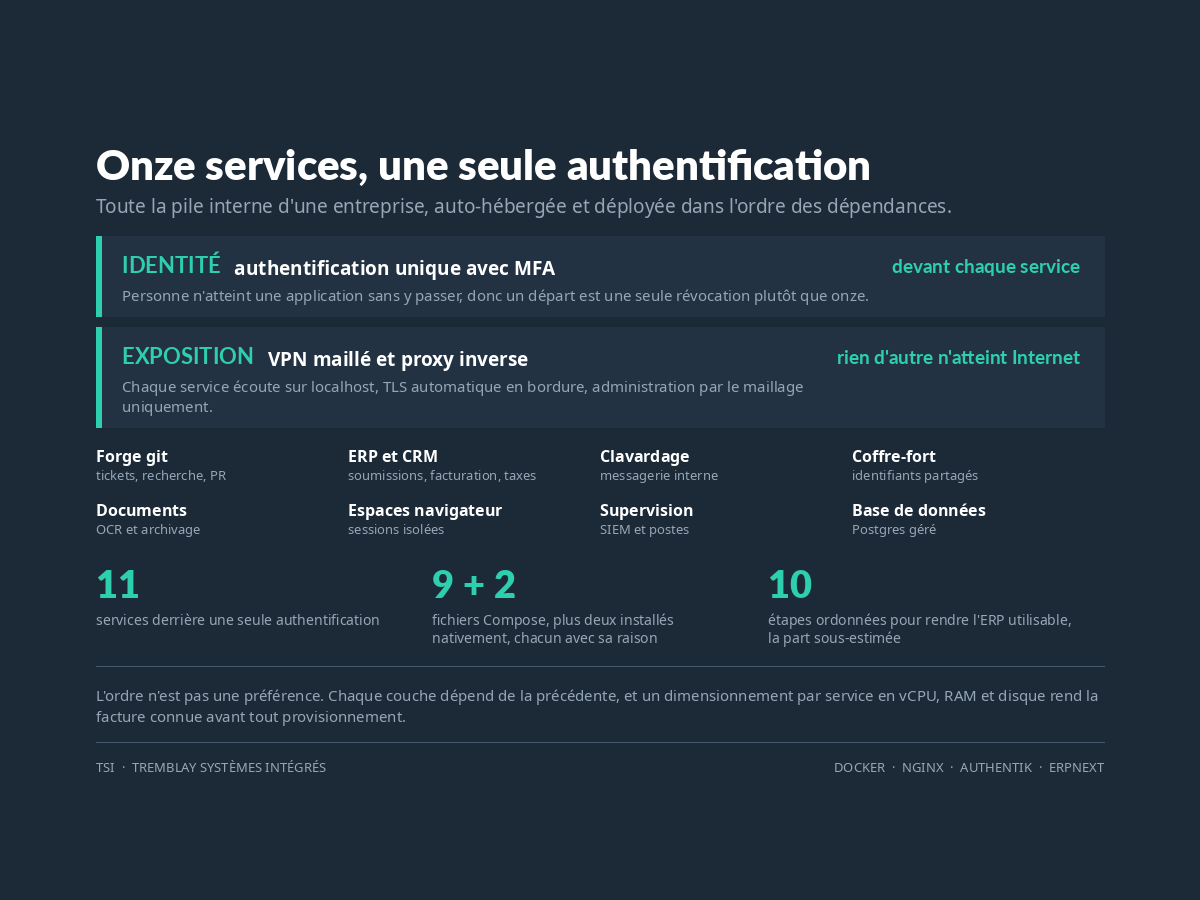
Neuf tournent en services Docker Compose et deux sont installés nativement, chacun avec une raison écrite du choix. Chaque service écoute sur localhost et n'est joignable de l'extérieur qu'à travers le proxy inverse. Ce qui rend l'ensemble reproductible plutôt qu'anecdotique, c'est l'ordre de déploiement, fixe parce que chaque couche dépend de la précédente, et un dimensionnement par service en vCPU, RAM et disque, de sorte que la facture d'hébergement est connue avant tout approvisionnement.
À quoi ça tient
L'ERP est la partie que l'on sous-estime le plus. Le mettre debout prend un après-midi. Le rendre utilisable est une configuration en dix étapes menée dans un ordre fixe : création de la société, plan comptable canadien avec les ajouts québécois, modèles de taxes pour la TPS et la TVQ, devises et taux de change, règles de territoire pour que la bonne taxe se choisisse d'elle-même, catalogue de services, étapes du pipeline CRM, un rôle restreint pour que les sous-traitants externes ne voient pas les dossiers clients, l'affectation des rôles, et la numérotation des factures. Sautez l'ordre et vous obtenez un ERP à démonter et à refaire.
Utile si vous remplacez une pile d'abonnements mensuels, quittez un hébergeur, devez satisfaire une exigence de résidence, ou souhaitez simplement dimensionner ce qu'il vous faudrait avant de vous engager.
PORTÉE ET LIMITES
Ceci décrit ce que déploient l'installateur et le manuel d'exploitation, et ce qui tourne sur notre propre parc. Ce n'est pas une affirmation que les onze services tournent au même endroit pour un client donné. L'ordre de déploiement et le dimensionnement par service sont le livrable ; ce qui est effectivement monté dépend du besoin.